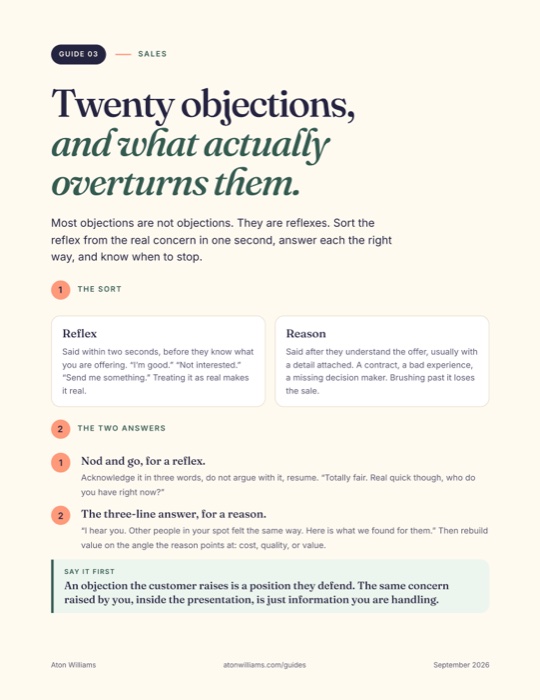
Reflex, or reason?
Smile first. Then decide which of two things you just heard. A reflex is a habit, not a concern: “I’m good,” “not interested,” “in a rush,” “just send me something.” A reason is a real hesitation: a bad past experience, a contract, a missing decision maker, a budget that does not exist yet.
Said within two seconds, before they know what you are offering. Treating it as real makes it real.
Said after they understand the offer, usually with a detail attached. Brushing past it feels dismissive and loses the sale.
Most reps lose on reflexes. They over-answer “I’m good” with a full rebuttal, and the customer, who was only brushing them off out of habit, now has a position to defend.
One answer for a reflex. A different one for a reason.
- Nod and go, for a reflex.
Acknowledge it in three words, do not argue with it, and resume. “Totally fair. Real quick though, what are you using for this right now?”
- The three-line answer, for a reason.
“I hear you. Other people in your spot felt the same way. Here is what we found for them.” Validate, show they are not alone, pivot to the answer. Then rebuild the value against their problem.
When you rebuild value, you have three angles: cost (dollars and time), quality (how well it actually performs), and value (what is included that they did not expect). Pick the angle the reason points at. A contract objection is a cost angle. A bad past experience is a quality angle. “We already have a vendor” is a value angle.
Take the objection away before they raise it.
An objection the customer raises is a position they now defend. The same concern, raised by you inside the presentation, is just information you are handling. If you know “I’m probably in a contract” is coming, you say “and even if you are still in a contract, here is how that gets handled” before they can plant a flag on it.
You waited for her to bring up the contract, then spent three minutes on defense. Next time it is one sentence inside the Show beat, and it never becomes a wall.
By medium, sorted, with the line.
Illustrative lines. Use your own words and only promise what your product does.
Face to face, retail or event
Nod and go. “Totally fair. Quick one while you are here: who do you have right now?”
Nod and go. “No problem. Most people say that before they hear the price. Thirty seconds?”
Nod and go. “Then I will be fast. One question and you are gone.” Ask the Story question.
Ask before you answer. “Good. What are you paying, and what is the one thing you wish it did better?” The answer tells you if there is a sale.
Three lines. “I hear you. Half the people I set up were mid-contract. Here is what we found: [what actually happens to their contract, truthfully].”
Three lines. “I get that. A customer last week said the same after a rough install. What we found is [what is different now, and your name on it].”
Respect it, then make it easy. “Makes sense. What would they want to know? Let us answer that now so you are not guessing later.” Set a time to reconnect.
Phone, cold call
Answer plainly, then go. “From [the honest source]. I will be quick. Do you have forty seconds for why I called?”
Nod and go. “Happy to. So I send the right thing, what happens today when a call comes in and nobody is free?”
Nod and go. “Understood. Is later today or tomorrow morning better? I will call then, not before.” Then actually call then.
Three lines. “Good. The people we help most said the same. What we found is one thing they did not know they were missing: [the one thing, specific].”
Ask what it is being compared to. “Compared to what you pay now, or to what it costs when a call goes unanswered?” Then rebuild value against the number they give you.
Recruit them. “Then you are the person who knows what they will ask. What would that be?” Ask for the introduction, not the sale.
Test it. “I can. What changes next quarter that makes this a better conversation?” If there is a real answer, book the date. If not, it was a reflex.
Meeting, B2B
Three lines. “Most of our clients did too. What we found is the gap was never the vendor, it was [the specific handoff or number]. Is that true here?”
Trade for a scope. “I will. To make it worth reading, give me twenty minutes on the two numbers it has to move.”
Ask where the cost lives now. “Understood. What is the problem costing you today, in hours or in lost deals?” If it is real, the budget exists somewhere. If it is not, respect the no.
Three lines. “I hear you. Two of our clients came off a failed rollout. What we found is it failed on [the specific thing], and here is how this one handles that.”
Make the meeting the next step. “Good. Who needs to be in the room, and can I be there to answer the hard questions myself?”
Answer in one sentence and ask. This is a deeper question, which means they are leaning in. Answer it against their problem and move to the Ask.
Two honest tries. Then respect the no.
Handle a reflex once and a reason once, each with the right answer. If it is still a no, thank them and move on with your energy intact. Some will, some will not, next. The rep who keeps pushing past two loses the customer and the referral. The rep who stops with grace gets both back later more often than you would think.
Sort your own objections.
The five you hear most. For each: reflex or reason, the angle, and your line. Entries stay on this page and are not sent anywhere.
Let a customer fire them at you.
Use this prompt with ChatGPT or Claude. Paste your top five. Remove anything confidential about your product first.
Play a customer for an objection drill.

My medium: [face to face at a retail location / a cold call / a scheduled business meeting]
My product, in one sentence: [describe it plainly, no claims you cannot back]
The five objections I hear most: [paste them]

Rules for you as the customer:
1. Fire the objections at me one at a time, in a realistic mix. Some should be reflexes said before you know the offer. Some should be real reasons with a detail attached.
2. After each of my responses, tell me in one line whether I treated it as a reflex or a reason, and whether that was right.
3. If I argue with a reflex, dig in the way a real person would. If I brush past a real reason, get colder.
4. If I answer a real reason with “I hear you, others felt the same, here is what we found,” respond honestly to whether the “found” part was specific enough to move you.
5. After five, score me: sorting accuracy, whether I picked the right angle (cost, quality, value), and whether I stopped after two honest tries. Give me the one line to practice next time.

Do not coach me mid-drill. Do not invent product capabilities. Respect a no.
One prompt. Paste it into Claude. It builds the whole thing for your business.
The Pro pack is a build prompt with blanks for your context: your product, your medium, your team. Fill them in, answer its questions, and it produces the complete system in your words. The PDF explains the method so you can judge the output. Forty objections sorted by reflex and reason, the answer builder, twelve value-rebuild lines, when-to-stop rules, a drill schedule, and three prompts.
- The build prompt: paste it into Claude, fill in the blanks, and it builds the whole system for your business
- Forty objections: the twenty from the free guide plus twenty more, each with the answer and medium notes
- The reflex-or-reason diagnostic, with the five-second test
- The three-line answer builder and twelve value-rebuild lines across cost, quality, and value
- When to stop: the rules that protect the customer and the brand
- A two-week drill schedule for a floor
- Three prompts: objection bank for your product, sparring partner, answer grader
Delivered as a zip: the build prompt as a text file, the PDF, and every prompt and template as plain text. One payment, yours to keep.