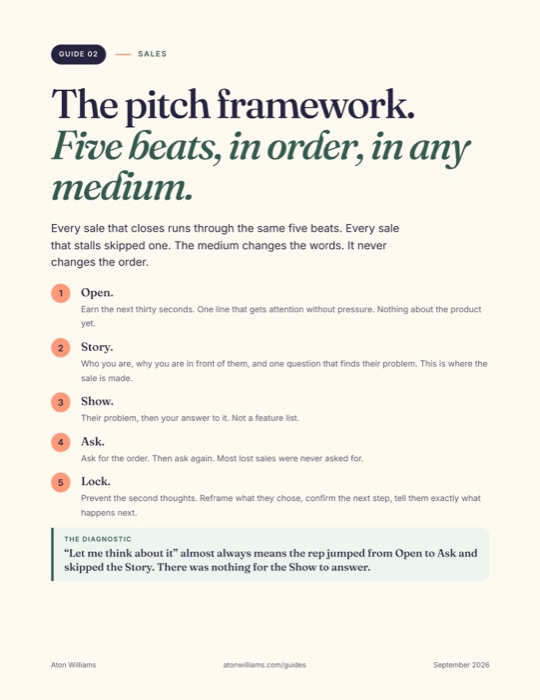
Five beats. Same order every time.
The medium changes the words. It never changes the order. When a rep is struggling, the first question is not “what did you say,” it is “which beat did you skip.”
- Open.
Earn the next thirty seconds. One line that gets attention without pressure. Nothing about the product yet.
- Story.
Who you are, why you are in front of them, and one question that finds their problem. This is where the sale is actually made, because the presentation only works if it answers something they said.
- Show.
Their problem, then your answer to it. Not a feature list. If they said the connection drops during online classes, you talk about the connection during online classes.
- Ask.
Ask for the order. Then ask again. Most lost sales were never asked for, or were asked for once, weakly.
- Lock.
Prevent the second thoughts before they start. Reframe what they chose, confirm the next step, exchange information, and tell them exactly what happens next so nothing surprises them.
“Let me think about it” almost always means the rep jumped from Open to Ask and skipped the Story. There was nothing for the Show to answer.
Same beats. Different words.
A line that works at a kiosk sounds wrong on a cold call and worse in a boardroom. Below, each beat in three mediums. The examples are illustrative. Only promise what your product actually does.
Open
“Quick question while you are here. What are you using for this right now?”
“This is Jordan with XYZ Company. I will be quick. Do you have forty seconds for the reason I called?”
“Before I show anything, can I ask what made you take this meeting?”
Story
“I am here today handling upgrades for the area. What are you paying now, and what is the one thing you wish worked better?”
“We work with businesses your size on getting the phone answered every time. What happens right now when someone calls and nobody is free?”
“We have set this up for three companies that look like yours. Where does your team lose the most time between a lead coming in and a real conversation?”
Show
“You said it fails right when you need it. Here is what changes about that specific problem, and here is what does not change.”
“You said calls go to voicemail after five. Here is what happens to that call instead, step by step.”
“You said the handoff between marketing and sales is where it breaks. Here is the handoff as it would run on Monday, using your names and your numbers.”
Ask
“Would mornings or afternoons be better to get you set up?”
“Let us get this set up so the next call after five gets answered. I can have it live Thursday or Friday. Which is better?”
“If the pilot starts the first of the month, who on your side owns it, and what would you need from us by the fifteenth?”
Lock
“So here is exactly what happens: a confirmation call today, the install window Thursday, and my number if anything looks off.”
“You will get an email in the next ten minutes with what we agreed. Reply to it with any question. Nothing changes until you have seen it in writing.”
“I will send the one-page scope tonight. You made a good call on the pilot, and here is why the first two weeks matter most.”
Know when to stop talking.
Most reps close too late. They keep presenting past the moment the customer was ready and talk them back out of it. Eight signals tell you they are ready. The rule: two positive signals, stop presenting, ask.
Each signal has a negative twin. “How much” said as “that is too much” is a negative. Deep questions about things you cannot provide are a negative. On a negative, do not ask. Go back to Show and rebuild the value against their problem.
Pick the ask that matches the temperature.
- Two options, both a yes.
“Thursday or Saturday?” “Mornings or afternoons?” Best for the fence-sitter, because “no” is not on the menu.
- Assume and proceed.
Start the paperwork while you say “let us get you set up.” Best for the customer who is clearly ready.
- A chain of small yeses.
“You want it faster, right? And cheaper than now? And this week?” Best for the analytical customer who needs to hear themselves agree.
You presented for four more minutes after she asked how soon someone could come out. Next time, that question is your cue to stop and ask.
Write the framework for your product.
In your medium, in your words. Entries stay on this page and are not sent anywhere. They clear when you leave or reload.
Run it against a customer before a real one.
Use this prompt with ChatGPT or Claude. Paste your five beats where marked. Remove anything confidential about your product first.
Play a customer for a sales practice session. I will run a conversation in five beats: Open, Story, Show, Ask, Lock.

My medium: [face to face at a retail location / a cold call / a scheduled business meeting]
My product, in one sentence: [describe it plainly, no claims you cannot back]
My five beats: [paste them]

Rules for you as the customer:
1. Stay in the medium. On a call, you cannot see me. In a store, you were walking somewhere.
2. Have one real problem in mind that my product could plausibly address. Do not volunteer it. Reveal it only if my Story beat earns it with a good question.
3. Give me two ready signals during the Show beat if I have tied it to your problem. Give me none if I am listing features.
4. If I skip a beat or jump to the Ask early, respond the way a real person would: “let me think about it.”
5. After I finish, score each beat from 1 to 5 with one sentence of evidence from what I said. Tell me which beat I skipped or weakened, and give me the one line I should practice next time.

Do not coach me during the conversation. Do not invent product capabilities. Respect a no.
One prompt. Paste it into Claude. It builds the whole thing for your business.
The Pro pack is a build prompt with blanks for your context: your product, your medium, your team. Fill them in, answer its questions, and it produces the complete system in your words. The PDF explains the method so you can judge the output. Every beat in three mediums with forty-five lines, three worked pitches, a seven-day drill plan, a scorecard, and four prompts.
- The build prompt: paste it into Claude, fill in the blanks, and it builds the whole system for your business
- The five beats explained in depth for retail and events, phone, and meetings
- Forty-five lines: three variants of every beat in every medium
- Three complete worked pitches for generic products you can swap for your own
- The eight ready signals and the three asks, with the words for each
- A seven-day practice plan and a ten-point pitch scorecard
- Four prompts: pitch builder, pitch critic, interruption trainer, medium translator
Delivered as a zip: the build prompt as a text file, the PDF, and every prompt and template as plain text. One payment, yours to keep.